
In the Red Zone: What a Heatwave Is Teaching Me About Rest, Performance, and the Limits of Pushing Through

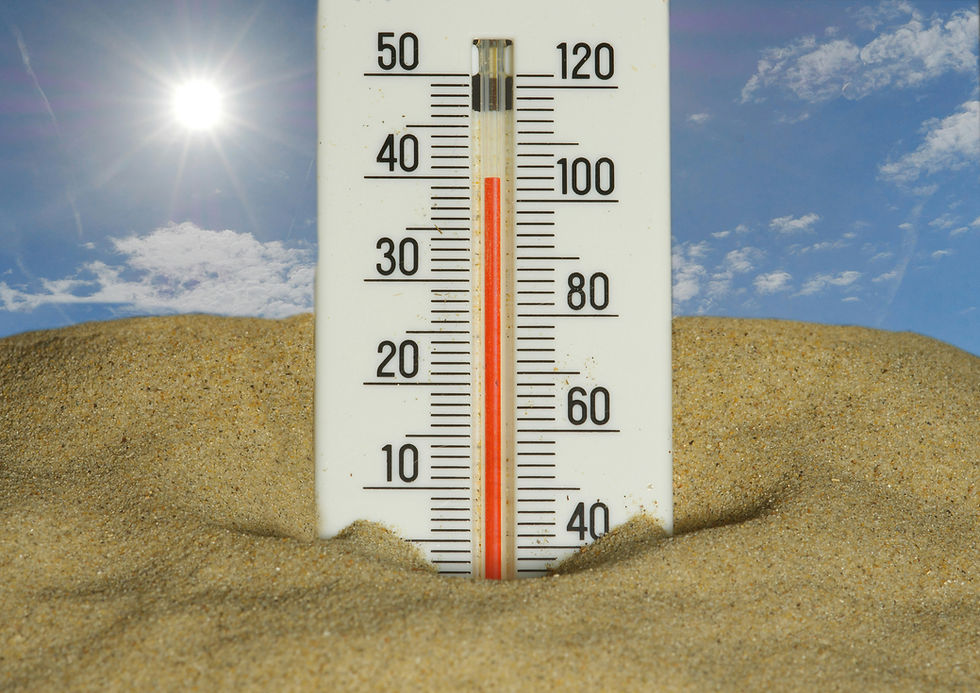
I am writing this in the middle of a heatwave, while visiting France, where record setting temperatures have been climbing past 40°C, and much of the country is under a red alert for extreme heat. Britain is in the same event. The scale differs; the experience of being too hot to function does not.
Plans have been cancelled. My body feels uncomfortable and hot. Cognitive function, usually reliable enough, has mostly gone offline. The version of me who manages and stays on top of things: she is not available right now. What remains is someone lying very still, trying not to think too hard, and finding that she cannot perform being okay even if she wanted to.
I have written before about self-care: what it is, why we resist it, and some practical ways into it. Read more here: What's Your Self-Care Plan? I am not going to cover that same ground here. What I want to write about instead is what happens when the choice is taken away from you. When the body removes the option to push through, and what that forces you to confront about your relationship with rest, with performance, and with your own limits.

The body as a boundary-setter
There is a frustration that comes with the body overriding the mind's agenda. I have things to do. I have a list. I have a sense of what I should be able to manage. But heat does not care about lists. When core body temperature rises, the nervous system deprioritises everything that is not essential for survival. Higher cognitive functions, including planning, concentration, and complex thinking, are among the first things to go. This is not a character flaw. It is thermoregulation. The brain is doing what it is supposed to do: keeping you alive, at the expense of your to-do list.
I know this. I know it theoretically. And yet the experience of sitting with cancelled plans and a foggy, sluggish mind still produced - initially at least - the very familiar feeling that I should be doing something. That resting feels like I’m being lazy, rather than it being an appropriate response to the heat. That gap, between knowing something intellectually and being able to apply it to yourself, is where a lot of the difficulty with rest actually lives.
Extreme heat can push the system toward shutdown. The appropriate response to shutdown is not to try harder. It is to reduce demand and support regulation.
Lying still in a cool room is not laziness. It is, in that context, exactly what the situation calls for. The difficulty is that many of us have spent years learning to override those signals, and the override has become so automatic that it continues even when the system is genuinely unable to comply.
What the heatwave has done, in a blunt and fairly unpleasant way, is remove the override. The system cannot be pushed past what it can sustain. That is not failure. It is just physiology, doing what physiology does.
The sensory weight of heat
There is also the specific sensory load that extreme heat brings. It is not just that it is hot. It is the quality of the air, thick and pressing. The feeling of skin that will not cool down. Fabric that becomes intolerable. Sound that lands differently when the nervous system is already working hard just to regulate temperature.
It is a bit like what happens to a laptop in the heat. The fan whirs. The processor slows. The device is not broken; it is redirecting its resources to stop itself overheating, which means less capacity for everything else. Our nervous systems are doing something similar.
Thermoregulation takes priority, and everything that was running alongside it, concentration, patience, sensory tolerance, emotional regulation, has to make do with what is left.
For those of us with sensory sensitivities under ordinary conditions, extreme heat does not add a single layer of difficulty. It compounds what is already there. The nervous system that is managing heightened sensory input on a normal day is now doing that work with significantly fewer resources, because those resources are elsewhere.
For many neurodivergent people, sensory differences mean that environments others find merely uncomfortable can become genuinely overwhelming. Interoception, the sense of what is happening inside the body, also varies between individuals, which affects how reliably someone can detect and respond to signals like overheating before they become acute.
Extreme heat removes the tolerance that usually allows someone to manage. What is left is the system operating with its margins stripped away.
The inner critic does not take the heat into account
The resistance to resting, even when the body is clearly asking for it, is not arbitrary. It is usually learned, and it is usually learned in a particular context.
Many people grew up in environments where rest had to be earned, or where being unproductive was equated with being a burden, or where pushing through was framed as the only honourable response to difficulty. Some people learned that their needs came last, or that expressing them was unsafe. These are not abstract beliefs. They are patterned responses built over years, often decades, and they do not dissolve simply because the temperature outside has hit 40°C.
At some point during this heatwave I noticed I was expending energy I do not have on feeling bad about not having energy. The inner critic, running on fumes, was still reliably producing output. That is not an efficient use of limited resources.
It is, in a grim way, almost impressive. The inner voice that says you should be doing something, even when you are in no state to do anything. Whose voice is that? What does it believe will happen if you stop? What has rest historically cost you? It's worth sitting with these questions, though perhaps not during a heatwave, when sitting with anything requires more cognitive resource than is currently available.
Capacity is not a character trait
One of the things the heatwave is making viscerally clear is that capacity is not fixed. It is not a character trait. It is not something you either have or do not have. It is a state that fluctuates in response to physical and environmental conditions: temperature, sleep, pain, sensory load, emotional weight, and a great many other things.
This matters because a lot of self-criticism is implicitly based on the assumption that capacity is constant. If I could do this yesterday and I cannot do it today, the conclusion drawn is often that something is wrong with me, or that I am not trying hard enough. Rather than that the conditions today are simply different from the conditions yesterday.
For people living with chronic illness, disability, or neurodivergence, this is familiar territory. The variability of capacity is not a mystery or a moral failing. It is the reality of living in a body that is affected by its environment.

Writing this from inside it
What is getting me through is fairly unglamorous. Cold water. Stillness. Letting go of planned activities. Paying attention to how I can make my environment work for me, including the small sensory details that become impossible to ignore in this kind of heat: which room is coolest, which fabrics are tolerable, how close I am to the fan, how much noise I can manage. The margins are smaller than usual, and I find myself working with that rather than against it.
If you would like to read more about self-care, including some practical ways into it, you can find my earlier blog on that here. And if you would like to explore any of this in counselling, you are welcome to get in touch and book a free 20 minute introductory call. 🌻
This article reflects general themes and the author's personal reflections. It does not draw on or describe the experiences of any individual client.
Further Information
If you are currently affected by extreme heat, the following resources offer practical advice on staying safe, keeping cool, recognising the signs of heat exhaustion and heatstroke, and supporting vulnerable family members, friends, and neighbours:
Please seek medical advice if you are concerned about symptoms of heat exhaustion or heatstroke, particularly for older adults, young children, people with underlying health conditions, and anyone struggling to stay cool during prolonged periods of extreme heat.


